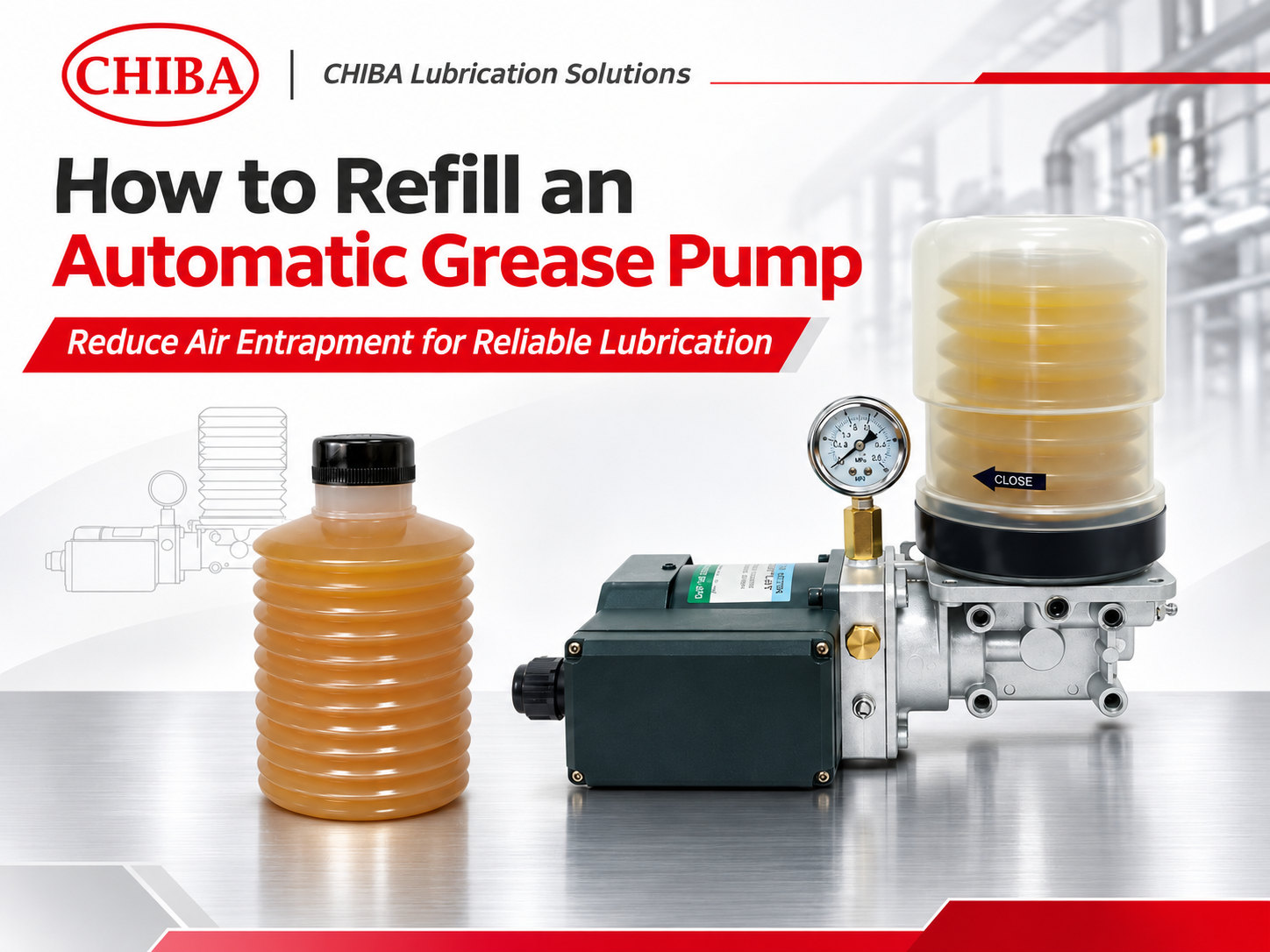
How to Refill an Automatic Grease Pump and Reduce Air Entrapment
Refilling an automatic grease pump is an important maintenance task, but improper filling can introduce air or contaminants into the lubrication system. This may cause inconsistent grease delivery, unstable pressure, or insufficient lubrication at critical machine components.
At YUNG TIEN LUBRICATION TECHNOLOGY CO., LTD., we manufacture CHIBA lubrication pumps and related components for industrial machinery. We understand that reliable lubrication depends on using the correct grease, following the proper filling method, and confirming that lubricant reaches the required points after maintenance.
This guide explains how to refill an automatic grease pump, minimize air entrapment, determine when priming or air bleeding may be necessary, and verify normal grease delivery.
Quick Answer: How Do You Refill an Automatic Grease Pump?
To refill an automatic grease pump, confirm the approved grease specification and reservoir configuration, clean the designated filling connection, and use the filling method specified for the pump. Avoid introducing air or contaminants, and do not exceed the permitted filling level or pressure. After refilling, check whether priming or air bleeding is necessary and verify grease delivery before returning the equipment to normal operation.
Table of Contents
- What Should You Check Before Refilling an Automatic Grease Pump?
- How to Refill an Automatic Grease Pump Properly
- How to Prevent Air Entrapment During Grease Refilling
- When Is Priming or Air Bleeding Necessary After Refilling?
- How to Verify Grease Delivery and Troubleshoot Problems After Refilling
- CHIBA Grease Lubrication Solutions – A Brand of YUNG TIEN LUBRICATION TECHNOLOGY CO., LTD.
- Frequently Asked Questions About Automatic Grease Pump Refilling
1. What Should You Check Before Refilling an Automatic Grease Pump?
Before refilling an automatic grease pump, identify the pump model, approved lubricant, reservoir configuration, and filling requirements. Different pump designs may use different grease consistencies, filling connections, and lubricant supply arrangements.
Checking these conditions first helps prevent incorrect lubricant selection, contamination, and air entering the supply path.
Pre-Refilling Checklist
| Inspection Item | What to Confirm |
|---|---|
| Pump model | Identify the pump model and applicable operating instructions. |
| Grease specification | Confirm the approved lubricant and NLGI consistency grade. |
| Grease compatibility | Verify compatibility before switching or mixing grease products. |
| Reservoir configuration | Identify the refillable reservoir or compatible disposable grease-pack arrangement. |
| Grease level | Check the remaining lubricant and specified refill level. |
| Filling connection | Inspect the designated filling port for contamination or damage. |
| Maintenance safety | Follow equipment isolation and pressure-release requirements. |
Why Grease Compatibility Matters
NLGI grades describe grease consistency, but they do not determine whether different lubricants are interchangeable.
Greases can vary in thickener chemistry, base oil, additives, operating-temperature suitability, and pumpability. Even products with the same NLGI grade may be incompatible.
Before changing grease, check the pump and lubricated components' requirements, along with the lubricant supplier's compatibility information.
Key Takeaways
- Confirm the pump model and approved lubricant before filling.
- Do not select grease based on its NLGI grade alone.
- Check the reservoir configuration and filling requirements.
Technical Reference: National Lubricating Grease Institute (NLGI)
2. How to Refill an Automatic Grease Pump Properly
The correct refill procedure depends on whether the pump uses a refillable grease reservoir or a disposable grease pack. Identifying the installed configuration is essential because the two methods require different handling procedures.
Refilling a Conventional Grease Reservoir
For an automatic grease pump with a refillable reservoir, use the following general maintenance procedure:
- Prepare the equipment: Follow the machine's safety instructions and place the lubrication system in the condition required for refilling.
- Clean the filling connection: Remove dirt and grease residue from the filling port and filling equipment.
- Confirm the approved lubricant: Check the grease specification and use clean, suitable filling equipment.
- Connect the filling equipment: Use the designated filling connection specified for the pump.
- Refill the reservoir: Follow the manufacturer's filling method, pressure limits, and permitted grease level.
- Complete the refill: Secure the connection, remove grease residue, and check for leakage or damage.
These steps provide a general maintenance framework. Actual filling equipment, operating conditions, and pressure limits must follow the instructions for the installed pump.
For example, the CHIBA MSK-1 grease lubrication pump has a designated filling connection, and its product information emphasizes correct filling practices.
Replacing a Disposable Grease Pack
Some grease lubrication pumps use compatible pre-filled grease packs, reducing the need to transfer grease into a conventional reservoir.
When replacing a disposable pack, confirm the approved replacement specification, follow the prescribed installation procedure, and check that the connection is properly secured.
Pack capacity or grease grade alone does not establish compatibility with a particular pump.
Refillable Reservoir vs. Disposable Grease Pack
| Item | Refillable Grease Reservoir | Disposable Grease Pack |
|---|---|---|
| Maintenance method | Add approved grease through the designated filling method. | Replace the compatible pre-filled pack. |
| Main consideration | Clean equipment and correct filling conditions. | Pack compatibility and installation. |
| Potential air entry | Filling equipment, connections, or interrupted grease supply. | Replacement interface or improper installation. |
| Contamination control | Depends on filling equipment and handling. | Reduces direct handling of grease during replacement. |
| Maintenance requirement | Check grease level and refill when required. | Replace the pack according to system requirements. |
The CHIBA MSK-1 product range includes configurations that may use a grease reservoir or disposable grease pack. The appropriate filling method depends on the actual installed arrangement.
Related Reading:
3. How to Prevent Air Entrapment During Grease Refilling
Air entrapment occurs when air enters the lubricant supply path or becomes trapped within the grease. Because air is compressible, its presence can interfere with pressure development and disrupt lubricant delivery.
Three Common Causes of Air Entrapment
1. Air Introduced During Filling
Air may enter through filling equipment, poorly prepared connections, or grease containing air pockets. This can interrupt the continuous flow of lubricant into the pump.
2. Air Drawn Into the Pump From an Empty Reservoir
When a refillable reservoir runs empty, the pump may draw air instead of grease. Adding new lubricant may not immediately restore the supply path if air remains inside.
3. Air Introduced During Pipeline Maintenance
Opening lubrication lines or replacing components can allow air into the circuit. Depending on the system arrangement, restoring normal delivery may require additional air bleeding.
Practical Ways to Minimize Air Entrapment
- Maintain the required grease level: Refill before the pump begins drawing air.
- Prepare filling equipment correctly: Use clean equipment and follow preparation instructions to minimize air transfer.
- Use the designated filling connection: Avoid opening unrelated parts of the lubrication circuit.
- Install grease packs properly: Follow the replacement procedure and confirm the connection is secure.
- Avoid unnecessary pipeline disconnection: Keep the grease supply circuit intact unless maintenance requires it.
Key Takeaways
- Air can enter during filling, through an empty reservoir, or during pipeline maintenance.
- Clean filling equipment and properly secured connections help reduce air entry.
- Preventing air entry is preferable to removing trapped air after delivery problems occur.
4. When Is Priming or Air Bleeding Necessary After Refilling?
Not every automatic grease pump requires priming or air bleeding after a normal refill.
These procedures may become necessary when the pump draws air, the lubricant supply path is interrupted, or maintenance introduces air into the circuit. The appropriate action depends on the pump and lubrication system design.
Priming vs. Air Bleeding: What Is the Difference?
Priming establishes or restores a continuous lubricant supply within the pump so that it can deliver grease.
Air bleeding removes trapped air from applicable parts of the lubrication system.
Although related, these procedures are not identical. Restoring grease delivery at the pump does not necessarily remove air trapped farther downstream.
When Should Priming or Air Bleeding Be Considered?
| Situation | Recommended Action |
|---|---|
| Normal refill before the reservoir runs empty | Verify normal operation. Additional priming may not be necessary if the supply path remains filled. |
| Reservoir has run completely empty | Check whether the pump has drawn air and follow the prescribed priming procedure if required. |
| Lubrication lines have been disconnected | Follow applicable restoration and air-bleeding instructions. |
| Pump operates but fails to deliver grease | Check grease supply, possible air entry, and other system faults before determining corrective action. |
Important Safety Precautions
Different pump models may use different venting points, operating modes, or restoration procedures. Do not loosen pressurized fittings or disconnect grease lines as an improvised air-bleeding method.
Pressurized grease can penetrate the skin and cause serious injury. Always follow the manufacturer's isolation, depressurization, and maintenance instructions before working on a pressurized component.
Safety Reference: UK Health and Safety Executive – Injection Injury
5. How to Verify Grease Delivery and Troubleshoot Problems After Refilling
A full reservoir and an operating pump do not guarantee that grease reaches every lubrication point.
After refilling, check the pump and connected lubrication circuit using the equipment's approved inspection procedures. This is especially important when the reservoir has run empty, a grease pack has been replaced, or lubrication lines have been opened.
Post-Refilling Inspection Checklist
- Pump operation: Confirm that the pump responds to its timer, PLC, or applicable control signal.
- Supply pressure: Check the expected working pressure where suitable monitoring is available.
- Piping and connections: Inspect accessible components for leakage or damage.
- Distributor operation: Verify the function of the installed distributor or metering components.
- Lubrication points: Confirm grease delivery using approved inspection or monitoring methods.
- System alarms: Check available monitoring devices for abnormal indications.
Different Systems Require Different Checks
In a progressive lubrication system, distributor-cycle monitoring can help confirm that the metering sequence is operating. However, a completed cycle alone does not guarantee that every downstream lubrication point has received its intended grease quantity.
In a pressure-relief lubrication system, inspection should follow the circuit's pressure build-up, pressure-release, and metering requirements. Progressive distributor-cycle monitoring should not be applied to a different system type without an appropriate monitoring arrangement.
Related Reading:
Common Problems After Refilling
| Symptom | Possible Cause | Recommended Check |
|---|---|---|
| Pump runs but no grease is delivered | Air in the supply path, interrupted supply, or pump fault. | Check lubricant supply and applicable priming requirements. |
| Expected pressure cannot be established | Air, leakage, unsuitable grease, or insufficient delivery. | Inspect filling conditions, grease compatibility, and connections. |
| Grease leaks from the filling connection | Improperly secured fitting, damaged seal, or excessive filling pressure. | Safely isolate the system before inspecting the connection. |
| Delivery stops after grease-pack replacement | Incompatible pack, incorrect installation, or interrupted supply. | Verify pack specification and approved installation procedure. |
| Distributor operation becomes abnormal after servicing | Air introduced during maintenance or a distribution circuit fault. | Check the circuit and applicable monitoring indicators. |
A single symptom may have more than one cause. Normal pump movement or pressure indication alone should not be treated as proof of complete lubrication.
If the required grease delivery cannot be verified, the affected equipment should not return to normal operation until the issue has been resolved.
Key Takeaways
- Verify grease delivery after refilling, not only pump operation.
- Use the correct inspection method for the installed distribution system.
- Resolve abnormal pressure, leakage, or interrupted supply before restarting machinery.
Related Reading:
6. CHIBA Grease Lubrication Solutions – A Brand of YUNG TIEN LUBRICATION TECHNOLOGY CO., LTD.
CHIBA is a lubrication system brand under YUNG TIEN LUBRICATION TECHNOLOGY CO., LTD. , a Taiwan-based manufacturer of industrial lubrication equipment and related components.
We manufacture lubrication pumps, distributors, and accessories for industrial machinery. Our product range includes automatic grease lubrication pumps for different lubricant supply and distribution arrangements.
CHIBA MSK-1 Automatic Grease Lubrication Pump
The CHIBA MSK-1 is a motor-driven grease lubrication pump in our grease-resistant lubrication product category.
Its published product features include:
- PLC-based pump operating and interval control
- Optional pressure monitoring
- Overload protection valve
- Reservoir and grease-pack configurations
When maintaining an MSK-1, the installed lubricant supply configuration should be identified before refilling.
View CHIBA MSK-1 Product Details
CHIBA MSK-10W Grease Lubrication Pump
The CHIBA MSK-10W is listed in our grease pressure-relief lubrication product category.
Its published features include controlled pump operation, optional pressure detection, and overload protection. The product description also emphasizes proper filling to avoid air-related lubrication problems.
Maintenance must follow the applicable pump configuration and designated filling procedure.
View CHIBA MSK-10W Product Details
CHIBA ASK-16A Disposable Grease Lubrication Pump
The CHIBA ASK-16A is an air-operated lubrication pump listed in our grease pressure-relief product category.
Its published features include pneumatic operation, external or PLC signal control, and use with applicable metering components.
The appropriate lubricant and grease-pack arrangement must match the specific pump configuration.
View CHIBA ASK-16A Product Details
CHIBA FS Disposable Grease
CHIBA FS Disposable Grease is a pre-filled grease product intended for compatible lubrication applications.
Its published specifications include:
- NLGI grease grades: 00 and 000
- 700 cc capacity
- Disposable grease packaging
Compatibility between the grease product, pack interface, and pump must be established before installation.
View CHIBA FS Disposable Grease Details Explore CHIBA Grease Lubrication Products:
7. Frequently Asked Questions About Automatic Grease Pump Refilling
How often should an automatic grease pump be refilled?
Refilling frequency depends on reservoir capacity, lubricant consumption, lubrication cycles, the number of connected lubrication points, and machine operating conditions.
There is no universal refill interval for every pump. For refillable reservoirs, establish a schedule based on actual grease consumption and maintain the required minimum lubricant level.
Can different grease types or grades be mixed during refilling?
Greases should not be mixed unless compatibility has been verified.
Greases with the same NLGI grade are not necessarily compatible, while different consistency grades do not automatically mean two products are chemically incompatible.
Thickener chemistry, base oil, additives, and the lubrication system's requirements all affect suitability. Confirm compatibility before changing or combining lubricant products.
Technical reference: National Lubricating Grease Institute
Can I use a manual grease gun to refill an automatic grease pump?
A manual grease gun may be suitable when the pump manufacturer specifically permits that filling method.
Before using one, confirm the designated filling port, connection compatibility, permitted filling pressure, and grease specification.
Do not assume that a standard grease gun is suitable for every automatic grease pump. Incorrect connections or excessive filling pressure may damage components and create safety hazards.
Maintain Reliable Grease Delivery with CHIBA Lubrication Solutions
Proper grease refilling helps reduce contamination, air entrapment, and interruptions in lubricant delivery. Using compatible grease, following the designated filling procedure, and verifying system operation afterward are important parts of preventive maintenance.
At YUNG TIEN LUBRICATION TECHNOLOGY CO., LTD., we provide CHIBA automatic grease pumps, lubrication distributors, and related components for industrial machinery.
If you are selecting an automatic grease pump or evaluating an existing lubrication system, share your equipment type, pump model, lubricant specification, and application requirements with us. We can discuss relevant CHIBA product options for your lubrication needs.
Contact CHIBA for Product Inquiries
More Articles
- What Is an Auto Grease Pump and How Does It Improve Equipment Uptime?
- How to Set an Automatic Lubrication Pump Cycle for Industrial Machinery
- How to Select a Progressive Lubrication System for Multi-Point Machinery
- Lubrication Pump Replacement Guide: What to Check Before Replacing an Obsolete or Failed Unit