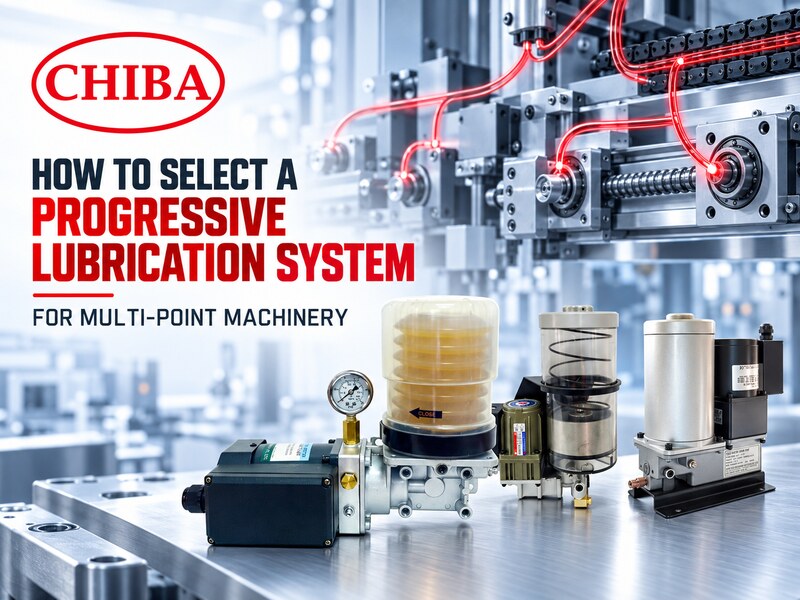
How to Select a Progressive Lubrication System for Multi-Point Machinery
When industrial machinery has multiple bearings, guides, gears, chains, or other friction points, installing a lubrication pump is only part of the solution. The system must deliver the required amount of lubricant to each point at appropriate intervals under actual operating conditions.
An automatic progressive lubrication system is a type of centralized grease lubrication system that combines a pump, progressive distributor, piping, and control components. However, the number of lubrication points alone does not determine whether this system is suitable. Lubricant properties, operating temperature, piping resistance, required output, control method, and monitoring requirements must also be evaluated.
YUNG TIEN LUBRICATION TECHNOLOGY CO., LTD. manufactures lubrication pumps, distributors, piping, accessories, and related lubrication components for industrial machinery. This guide explains what machine builders, maintenance engineers, system integrators, and purchasing teams should confirm before selecting a progressive lubrication system.
Quick Answer A progressive lubrication system should be selected according to the machine’s lubrication-point layout, required lubricant quantity, grease specification, piping resistance, working temperature, electrical controls, and monitoring requirements—not only the number of lubrication points or the pump’s maximum pressure.
Table of Contents
- Is a Progressive Lubrication System Right for Your Machinery?
- How Does a Progressive Lubrication System Work?
- What Information Should Be Confirmed Before System Selection?
- How Do Grease Grade, Temperature, and Piping Affect Delivery?
- How Can Blockages and Incomplete Lubrication Cycles Be Detected?
- How to Evaluate CHIBA MSK Grease Lubrication Pumps
- Frequently Asked Questions About Progressive Lubrication Systems
1. Is a Progressive Lubrication System Right for Your Machinery?
A progressive lubrication system is worth evaluating when a machine has multiple points that require grease at controlled intervals. It can be particularly useful when those points are difficult to reach, located around moving components, or unsafe to lubricate manually while the machine is operating.
Common situations include:
- Multiple bearings, guides, gears, chains, or sliding components require regular greasing.
- Manual lubrication takes too much maintenance time.
- Some lubrication points are difficult or unsafe to access.
- Lubrication intervals vary between operators.
- The machine must stop before maintenance personnel can reach the grease fittings.
- Lubrication needs to be integrated with a PLC, timer, or machine operating cycle.
- Maintenance personnel need to monitor whether a lubrication cycle has been completed.
Suitability depends on more than the number of lubrication points. The machine layout, lubricant, operating conditions, piping arrangement, and control requirements must also be reviewed.
A system designed for one machine may not suit another without reevaluating these conditions. Selection should therefore be based on the machine’s actual lubrication requirements rather than copied from a superficially similar application.
Key Takeaways
- Progressive lubrication can be suitable for machinery with multiple grease points.
- Machine layout and operating conditions are as important as the number of points.
- The system should be selected according to actual lubrication requirements.
Related Reading: How Do I Know If My Equipment Needs an Automatic Lubrication System?
2. How Does a Progressive Lubrication System Work?
A typical progressive lubrication system consists of a reservoir, lubrication pump, main supply line, progressive distributor, branch lines, and connected lubrication points. Depending on the machine requirements, it may also include a timer, PLC interface, pressure sensor, cycle switch, lubricant-level switch, or alarm output.
Reservoir → Pump → Main Line → Progressive Distributor → Lubrication Points
The pump supplies lubricant to the progressive distributor. Pistons inside the distributor operate in a defined sequence, metering lubricant through the configured outlets before the distributor can complete a full cycle.
The quantity delivered to each lubrication point depends on:
- Distributor outlet displacement
- Outlet combination and configuration
- Number of operating cycles
- Pump operating time
- Lubrication interval
- Lubricant flow characteristics
- System back pressure
The pump’s rated flow does not, by itself, determine how much grease each machine component receives. The distributor configuration, operating cycle, and required quantity at each point must also be considered.
If an outlet, internal passage, branch line, or lubrication point becomes severely restricted, the affected progressive distributor or circuit may be unable to complete its sequence. This sequential operation can support system monitoring when suitable sensors and control components are installed.
Key Takeaways
- A progressive distributor meters lubricant through a defined operating sequence.
- Pump flow alone does not determine the quantity delivered to each point.
- The pump, distributor, piping, and controls must be evaluated as one system.
3. What Information Should Be Confirmed Before System Selection?
Before selecting a progressive lubrication pump and distributor, we recommend preparing a lubrication map of the machine. It should identify each lubrication point, its location, required lubricant quantity, and planned lubrication interval.
Different bearings, guides, gears, and chains may require different quantities. Lubricant demand should be determined for each point rather than estimated by simply dividing the total pump output equally.
Progressive Lubrication System Selection Checklist
| Category | Information to Provide |
|---|---|
| Machine | Type, application, load, speed, and daily operating hours |
| Lubrication points | Quantity, location, and distance from the pump |
| Lubrication demand | Required amount and interval for each point |
| Lubricant | Product name, grease grade, and operating temperature |
| Distribution | Distributor type, outlet quantity, and required displacement |
| Piping | Length, internal diameter, fittings, and routing |
| Electrical system | Voltage, frequency, and connector requirements |
| Controls | Timer, PLC, manual command, or machine-cycle control |
| Monitoring | Pressure, lubricant level, or distributor-cycle feedback |
| Installation | Mounting space, reservoir capacity, and refill access |
The electrical and control method must also be confirmed before ordering. Depending on the equipment, the lubrication cycle may be controlled by an internal timer, external timer, PLC command, manual button, or machine-cycle signal.
If the machine requires alarms or operational feedback, specify the required signals in advance. Monitoring functions are not automatically included in every pump or system configuration.
Key Takeaways
- Prepare a lubrication map before selecting the system.
- Determine the lubricant demand at each point.
- Confirm control, monitoring, and installation requirements before ordering.
Related Reading: Lubrication Pump Replacement Guide: What to Check Before Replacing an Obsolete or Failed Unit
4. How Do Grease Grade, Temperature, and Piping Affect Delivery?
Grease is generally more difficult to transport through a centralized lubrication system than low-viscosity oil. Delivery resistance can vary considerably with lubricant consistency, temperature, piping dimensions, distributor design, and lubrication-point back pressure.
Grease Grade and Pumpability
A thicker grease generally requires more force to move through the system. However, grease grade alone does not provide all the information needed to predict delivery performance.
Other relevant properties may include:
- Base oil viscosity
- Thickener type
- Pumpability
- Temperature behavior
- Oil separation stability
- Compatibility with seals and machine components
The selected lubricant must be suitable for both the lubrication system and the machine components. An approved grease should not be changed merely to accommodate a particular pump without confirming its suitability for the bearings, guides, gears, seals, and other friction points.
The National Lubricating Grease Institute’s definition of NLGI grade explains that the grade classifies grease consistency. It should not be treated as the only indicator of whether a grease can be pumped through a specific lubrication circuit.
Operating Temperature
Low temperatures can reduce grease flow and increase system resistance. This may extend the time required to complete a lubrication cycle or prevent the lubricant from reaching distant points as expected.
High temperatures may affect grease consistency, retention, or performance at the lubrication point. The grease should therefore be evaluated according to the actual operating environment rather than only at room temperature.
Piping Length and Diameter
Long or narrow piping can increase resistance. Additional fittings, sharp bends, damaged tubing, and complex routing may further affect lubricant delivery.
The evaluation should include:
- Distance between the pump and distributor
- Distance between the distributor and each lubrication point
- Tubing internal diameter
- Number of fittings and bends
- Distributor design
- Grease behavior at the working temperature
- Back pressure at the connected components
The pump’s maximum output pressure should not be treated as the system’s normal operating target. A higher pressure rating does not automatically provide better lubrication. The pump must supply the required quantity while the distributor, tubing, fittings, seals, and connected components remain within their allowable pressure ranges.
Key Takeaways
- Grease pumpability changes with temperature and lubricant properties.
- Long or narrow piping can increase delivery resistance.
- Pump pressure and component pressure limits must be evaluated together.
5. How Can Blockages and Incomplete Lubrication Cycles Be Detected?
Because a progressive distributor operates in sequence, a blockage in an outlet, internal passage, branch line, or lubrication point may prevent the affected distributor or circuit from completing its cycle.
This behavior can help reveal a system problem, but it does not mean that every progressive lubrication system automatically detects blockages.
Actual monitoring capability depends on the installed components and control logic. Depending on the selected configuration, monitoring may involve:
- Pressure sensors or pressure switches
- Distributor cycle switches
- Lubricant-level switches
- Motor status signals
- PLC timing logic
- Incomplete-cycle alarms
- General lubrication alarms
An abnormal pressure increase may indicate hardened grease, a blocked distributor, a restricted fitting, damaged tubing, or a blocked lubrication point. Insufficient pressure may result from an empty reservoir, trapped air, leakage, a disconnected line, unsuitable grease, pump wear, or incorrect settings.
An alarm indicates that the circuit requires inspection, but it does not necessarily identify the exact fault location. Maintenance personnel should inspect the complete lubrication circuit before assuming that the pump has failed.
System Inspection Checklist
- Confirm that the pump starts and stops correctly.
- Confirm that the system reaches the expected working pressure.
- Verify that the progressive distributor completes its cycle.
- Check that lubricant reaches every connected lubrication point.
- Confirm that the farthest point receives sufficient lubricant.
- Inspect the pump, distributor, tubing, and fittings for leakage.
- Test all installed monitoring and alarm functions.
Key Takeaways
- A blockage may stop the affected distributor or circuit from completing its cycle.
- Fault detection requires suitable sensors, switches, or PLC logic.
- Troubleshooting should cover the complete lubrication circuit.
Related Reading: Top 5 Common Lubrication Failures and How Auto Grease Pumps Prevent Them
6. How to Evaluate CHIBA MSK Grease Lubrication Pumps
Our MSK-1, MSK-2, and MSK-6 units can serve as lubricant supply pumps in a properly configured lubrication circuit. A complete progressive lubrication system also requires a compatible distributor, piping, fittings, controls, and correctly configured lubrication points.
Final compatibility must therefore be evaluated according to the complete application.
CHIBA MSK-1
Published MSK-1 configurations include 110 V, 220 V, and DC 24 V models. The product information also lists:
- Motor-driven gear mechanism
- PLC control of operating and interval times
- Stable lubricant output
- Adjustable overload protection
- Optional pressure sensing
- 700 cc reservoir
- Published flow rate of 200 cc/min
- Published maximum output pressure of 50 kg/cm²
Published grease compatibility information varies between the feature description and specification table. The required grease product, grade, and operating temperature should therefore be confirmed with us before selection.
CHIBA MSK-2 and MSK-6
Published information for the MSK-2 and MSK-6 identifies:
- PLC or timer-based control of lubricant supply and pause times
- High-pressure output for higher-viscosity grease
- Overload safety valve for pump and piping protection
These features alone are not sufficient for final model selection. We must also confirm the required output, normal working pressure, grease properties, temperature, reservoir requirement, electrical specification, distributor configuration, piping resistance, and monitoring needs.
We evaluate the MSK unit as part of the complete lubrication circuit rather than as an isolated component. This helps ensure that the pump works with the lubricant, progressive distributor, piping, electrical controls, and actual operating conditions.
Explore CHIBA Grease Lubrication Products:
Key Takeaways
- An MSK unit supplies lubricant but does not form a complete progressive system by itself.
- Pump and distributor compatibility must be confirmed.
- Final selection depends on lubricant, pressure, output, piping, voltage, and controls.
7. Frequently Asked Questions About Progressive Lubrication Systems
How many lubrication points can a progressive lubrication system support?
There is no universal number that applies to every system. The supported quantity depends on the distributor arrangement, outlet configuration, required quantity at each point, pump capacity, lubrication interval, piping resistance, and operating conditions. The number of points must be evaluated as part of the complete system design.
Can a progressive lubrication system handle different grease grades?
A progressive system can use compatible grease or fluid grease, but the acceptable lubricant depends on the pump, distributor, piping, working temperature, and published product specifications. Before selection, provide the exact grease product and grade. Do not change the machine’s approved lubricant solely to match the pump without confirming component compatibility.
What happens if one lubrication line or distributor outlet becomes blocked?
A severe blockage may prevent the affected progressive distributor or circuit from completing its sequence. System pressure may rise, and connected lubrication points may not receive the intended lubricant. If suitable pressure or cycle monitoring is installed, the control system may generate an alarm. Further inspection is still required to locate the problem.
What information should I provide when requesting a progressive lubrication system?
Please provide the machine type, lubrication-point layout, required delivery quantities, grease specification, operating temperature, piping distances, voltage, control method, installation conditions, and monitoring requirements. Providing complete information allows us to evaluate the pump, distributor, piping, and controls as one lubrication solution.
Select the Complete Lubrication System Around Your Machinery
Selecting the pump is only one part of building a dependable progressive lubrication system. We evaluate the lubricant, distributor, piping, controls, and operating conditions together so that the complete circuit matches the machinery’s actual lubrication requirements.
If you are planning a new multi-point lubrication system or reviewing an existing circuit, provide us with your application information. We can help evaluate a suitable CHIBA lubrication solution for your machinery.